

HVAC & Air Duct Mold • Inwood, NY
HVAC and Air Duct Mold Remediation Inwood, NY
HVAC and duct mold grows where cool, wet surfaces meet warm, humid air, most often the evaporator coil, the condensate drain pan, and duct interiors. Unlike mold confined to one room, contamination within an HVAC system can potentially be distributed through the air pathways serving multiple rooms when the system operates.
Serving Inwood and the Five Towns
Same day response when available
Why HVAC Systems Are Prone to Mold
Why HVAC Systems Are Prone to Mold
HVAC air duct mold remediation Inwood is especially important when persistent moisture develops around cooling system components and creates conditions that can support mold growth. An air conditioning system is built around a simple contradiction: it needs cold surfaces to remove heat and humidity from the air, while persistent moisture on or around those surfaces can create conditions that support mold growth. The evaporator coil cools and dehumidifies incoming air, and the moisture it pulls out of the air condenses directly on the coil, then drips into a condensate drain pan. During Long Island’s humid summer months, when cooling systems run for extended stretches, that coil can stay wet for much of the day.
Problems start when that moisture does not drain properly, or when it accumulates somewhere it should not. A clogged or improperly sloped condensate drain line can let water sit in the pan far longer than it should, and in some cases overflow into surrounding insulation. An oversized air conditioning system can also make things worse by short cycling, reaching its temperature setting and shutting off quickly, which does not give the coil enough time to dry between cycles.
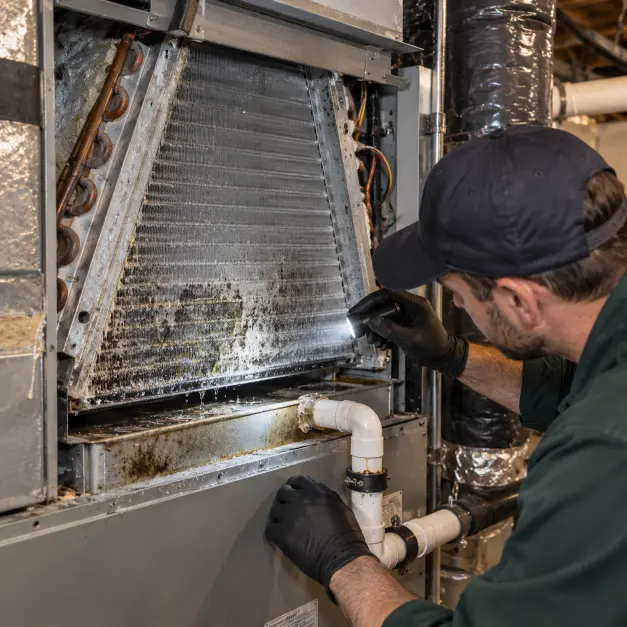
Where Mold Actually Forms in an HVAC System
Where Mold Actually Forms in an HVAC System
- The evaporator coil, where condensation is a normal part of operation but can become a growth site if airflow, drainage, or filtration is not maintained
- The condensate drain pan and drain line, particularly when clogged or sloped incorrectly
- The air handler interior, where fine dust that gets past filters accumulates and, combined with any nearby moisture, provides organic material for growth
- Duct interiors, especially insulated flexible ductwork and fiberglass duct liner. This material’s fibrous surface traps dust and resists effective cleaning once contaminated, which is why it is generally replaced rather than cleaned once mold is present
- Ductwork running through unconditioned spaces, such as a basement, crawl space, or attic, where duct surfaces can develop their own condensation if not properly insulated, separate from anything happening at the coil
Homes in Inwood where ductwork runs through a basement already prone to dampness can face this issue from two directions at once, general basement humidity and coil related moisture both reaching the same ducts.
Cleaning Versus Replacement
Cleaning Versus Replacement
Not every part of a contaminated HVAC system gets treated the same way. EPA guidance and industry guidance from organizations such as NADCA and NAIMA support replacing wet or moldy fiberglass duct material when it cannot be effectively cleaned, since its structure can hold contamination that resists effective removal. Hard, non-porous components, such as the coil itself, the drain pan, and metal duct surfaces, can typically be cleaned and treated rather than replaced.
The EPA’s own guidance on duct cleaning is also worth noting directly: cleaning is recommended when there is visible mold growth, signs of pest infestation, or excessive debris release into the home, not simply on a routine schedule. Cleaning ductwork that has no actual contamination does not meaningfully improve air quality and is not something a straightforward inspection would recommend.
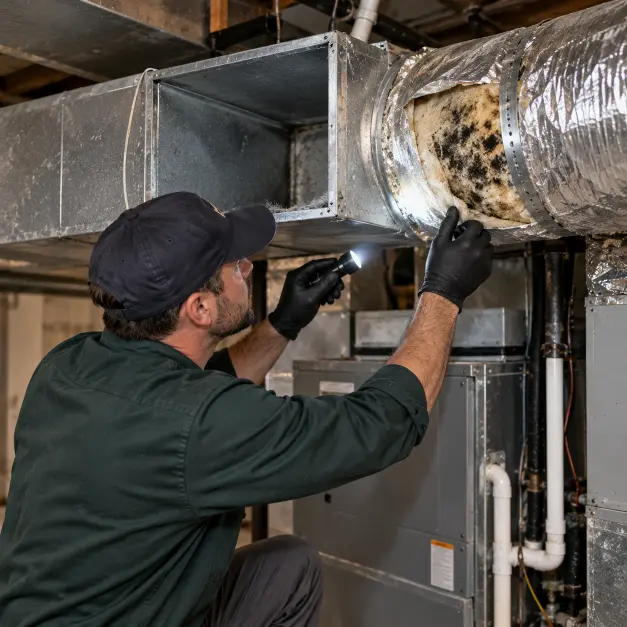
Our Approach
Our Approach to HVAC Air Duct Mold Remediation Inwood
1
Inspection of the coil, drain pan, air handler, and accessible ductwork
distinguishing actual mold from ordinary dust or debris.
2
Moisture source identification
since a coil or drain pan that stays wet due to a clogged line or an oversized system will develop mold again after cleaning if that cause is not fixed first.
3
Containment
appropriate to the scope of the affected components.
4
Cleaning and treatment of salvageable hard surfaces
including the coil, drain pan, and metal duct interior.
5
Removal and replacement of contaminated porous duct material
such as moldy flex duct or fiberglass duct liner, following EPA and NADCA guidance rather than attempting to clean it in place.
6
Correcting the underlying cause
which may involve clearing or resloping a condensate drain line, addressing an oversized or short cycling system, sealing duct leaks, or improving insulation on ducts running through unconditioned spaces.
7
Confirming airflow and drainage are restored
before the system returns to normal operation.
For mold assessment or remediation work covered by New York State Article 32, homeowners should verify that the professional holds the appropriate NYS mold license.
Frequently Asked Questions
Frequently Asked Questions
Why does my house smell musty only when the AC or heat turns on?
This is a common sign of mold or moisture somewhere in the system itself, often the evaporator coil, drain pan, or ductwork, since the smell only circulates when air is actively moving through the affected component.
Can moldy ductwork just be cleaned instead of replaced?
It depends on the material. Hard duct surfaces can generally be cleaned. Wet or moldy fiberglass duct liner and flexible duct insulation are generally replaced rather than cleaned, following EPA and NADCA guidance, since that material’s structure holds contamination that resists effective removal.
Do I need my ducts cleaned every year?
Not necessarily. The EPA recommends duct cleaning when there is documented mold, pest activity, or significant debris, not on a fixed schedule. Routine dust buildup alone is not generally a reason for cleaning.
Will duct cleaning fix a mold problem permanently?
Only if the moisture source is also corrected. Cleaning a coil or duct that continues to collect moisture from a clogged drain line or an underlying humidity problem typically leads to the mold returning.
Is HVAC mold dangerous if it is spreading through my whole house?
Health effects vary by individual and exposure level, similar to mold anywhere else in a home. People with asthma, allergies, or respiratory sensitivities are generally more affected. If you have specific health concerns, speak with a healthcare professional. The main practical concern with HVAC mold is that a running system can distribute spores more broadly than mold confined to a single room.
Can an oversized air conditioner actually cause mold?
Indirectly, yes. A system that is too large for the space can short cycle, shutting off before the coil has time to dry between runs, which keeps it wetter than a properly sized system would.
For a broader look at how remediation works, see our Mold Remediation page. If ductwork runs through a damp basement or crawl space, see Basement and Crawl Space Mold Removal. This service is available across Inwood, NY and the Five Towns.
HVAC & Air Duct Mold
HVAC and Air Duct Mold Remediation Inwood, NY
Sources Referenced
Sources referenced: U.S. Environmental Protection Agency, National Air Duct Cleaners Association, North American Insulation Manufacturers Association, New York State Department of Labor Mold Program and Labor Law Article 32.