
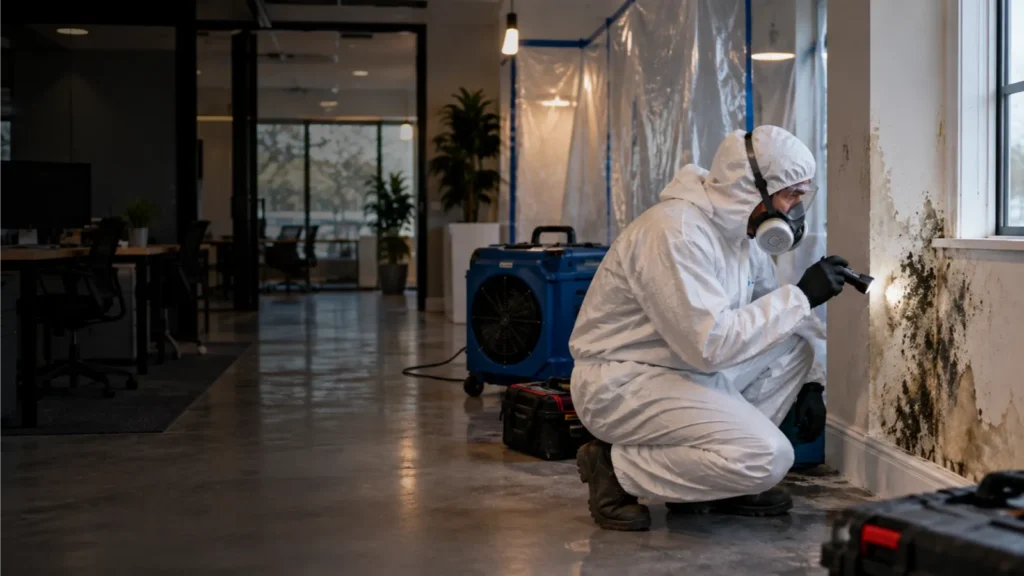
Commercial Mold Remediation • Inwood, NY
Commercial Mold Remediation Inwood, NY
Commercial mold remediation addresses offices, retail stores, restaurants, and multi-tenant buildings, where the priority is often minimizing disruption to a business while the work gets done.
Inwood & Five Towns
Offices, retail & restaurants
Multi-tenant coordination
What Makes Commercial Remediation Different
Remediation has to work around the business.
The physical work of removing mold and correcting a moisture source is broadly similar between a home and a business. What changes is everything around it. A retail store or restaurant generally cannot simply close for the length of a project the way a homeowner might vacate a room.
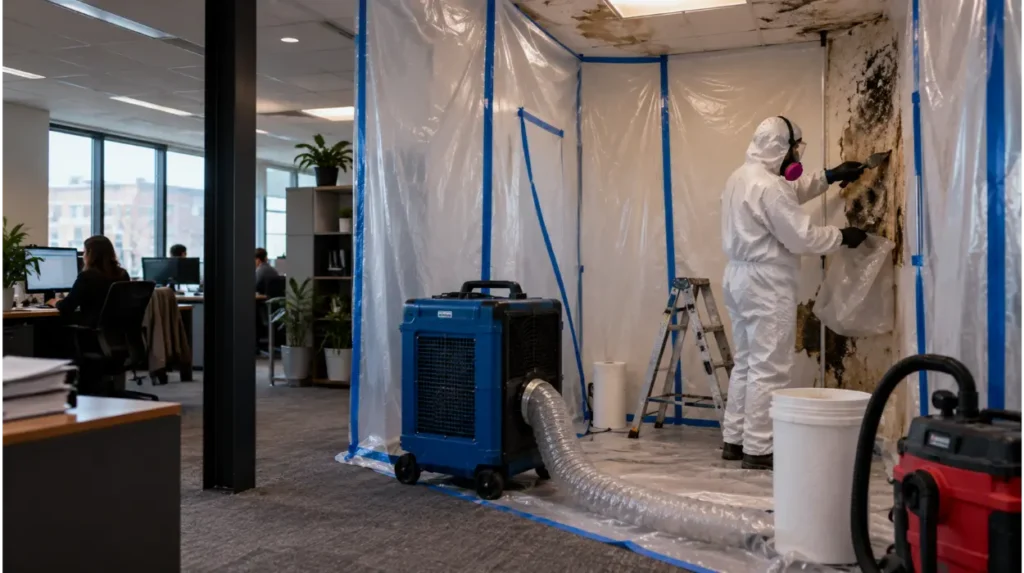
Scheduling around business hours, working in phases, or containing work to specific areas while the rest of the space stays open are common considerations that rarely come up in a residential job.

Employer Obligations Under OSHA
Workplace safety matters when employees are involved.
For business owners with employees, mold is not only a property maintenance issue but a workplace safety consideration. OSHA does not have a mold-specific exposure standard, and no federal agency has set specific limits for airborne mold spore concentrations. However, the General Duty Clause of the Occupational Safety and Health Act requires employers to provide a workplace free from recognized hazards likely to cause serious harm. In practice, this means a known mold problem that goes unaddressed can expose an employer to liability under that general standard, even without a mold-specific regulation being cited directly.
Employee reports of symptoms tied specifically to being in the workplace, musty odors, visible water damage, or ventilation problems are generally treated as the kind of evidence that supports taking the issue seriously rather than waiting for a more severe outcome.
Common Commercial Sources of Mold
Where commercial mold problems can start
Roof leaks and flat roof drainage issues
Common in retail and office buildings with different roofing systems than typical residential construction.
Larger, more complex HVAC systems
Rooftop units serving multiple zones can affect a much larger footprint when coil and drain pan problems occur.
Plumbing serving multiple units
A leak in one space can affect a neighboring tenant before it is discovered.
Basement and storage areas
Older commercial buildings may have lower-level areas that are less frequently inspected.
Walk-in coolers and food service equipment
Restaurants can have condensation and drainage issues similar to residential kitchen problems, at a larger scale.
Business Interruption & Documentation
Document the condition and protect continuity where possible.
Commercial property insurance sometimes includes business interruption coverage, which can help offset lost income during a closure, though this depends entirely on the specific policy and cause of the mold. A written scope of work, photos of the affected area, and any available testing results can support an insurance claim and communication with tenants, employees, or customers. Confirm your specific coverage directly with your commercial insurance provider rather than assuming it applies.
Our Approach
A commercial remediation plan built around the operation.
1
Assessment and scheduling around your operation.
Understanding business hours, customer flow, and any areas that need to stay accessible shapes how the work is planned.
2
Moisture source investigation
Commercial buildings can have several possible sources given their size and system complexity.
3
Containment
Often designed to isolate work from occupied or customer facing areas rather than closing the entire space.
4
Removal and treatment
Remove contaminated material and treat salvageable structure, following the same general principles used in residential remediation.
5
Coordination
Coordinate with building management, other tenants, or ownership as needed, particularly in multi-tenant properties.
6
Documentation
A written scope and available testing results can be useful for insurance and communication with employees or customers.
7
Post-remediation assessment
When appropriate for the scope of the project.
Frequently Asked Questions
Common questions about commercial mold remediation Inwood
Do I have to close my business during mold remediation?
Not necessarily. Many commercial jobs are scheduled around business hours or phased to keep most of the space operational, depending on the size and location of the affected area.
Who is responsible for mold in a rented commercial space, the landlord or the tenant?
This is generally defined by the specific lease. Some leases place maintenance and structural responsibility on the landlord, while tenant improvements or tenant caused damage may fall to the tenant. Review your lease’s specific language rather than assuming.
Can an employee file an OSHA complaint over workplace mold?
Yes. While OSHA does not have a mold-specific standard, the General Duty Clause allows for action against a known, unaddressed hazard, and employee complaints about symptoms tied to the workplace are a common way these issues come to attention.
Does commercial insurance cover mold remediation?
It depends on the specific policy and the cause of the mold, similar to residential coverage. Business interruption coverage, if included in your policy, may help with income lost during a closure. Confirm your specific coverage with your provider.
Is commercial mold remediation more expensive than residential?
Cost depends on the scope and complexity of the project rather than the property type alone, though commercial HVAC systems and larger affected areas can increase cost compared to a typical residential job.
Do multi-tenant buildings need special coordination for mold issues?
Often, yes, particularly when a shared wall, common area, or building-wide system like HVAC or plumbing is involved. Addressing the issue may require coordination between multiple tenants and building ownership or management.
Need Commercial Mold Help?
Call now and explain what is happening at the property.
Tell us about the leak, visible mold, musty odor, HVAC concern, affected tenant area, or other issue affecting the business space.

About the Service
Commercial mold remediation for Inwood and the Five Towns
This service is intended for offices, retail stores, restaurants, and multi-tenant properties where remediation must account for business operations, occupied areas, documentation, and coordination between the relevant parties.
For related services, see our Mold Remediation page and HVAC and Air Duct Mold Remediation page. For the wider service area, see Inwood, NY and the Five Towns.